Introduction
Monitoring your dog or cat’s blood pressure at home with the Contec 08a is a proactive way to look after their cardiovascular health. However, the accuracy of this tool crucially depends on one detail: the correct choice and use of the cuff. Whether for a small cat, a medium-sized dog, or a 54-kilogram giant, selecting the appropriate size and applying it correctly are essential steps. This updated guide aims to clarify all your doubts, integrating practical tips, detailed illustrations, and answers to the most frequently asked questions, so you can use the Contec 08a with confidence and obtain reliable results.
The Critical Importance of the Right Size
Using an incorrectly sized cuff is like trying to wear a shoe that doesn’t fit: it simply doesn’t work properly. In terms of blood pressure, the consequences are even more serious. A cuff that is too small excessively compresses the limb, resulting in falsely high readings, which can lead to an incorrect diagnosis of hypertension. Conversely, a cuff that is too large cannot apply pressure evenly, generating falsely low readings, which can mask a real high blood pressure problem. Therefore, accuracy starts with choosing the right size.
Step 1: Measuring the Limb Circumference
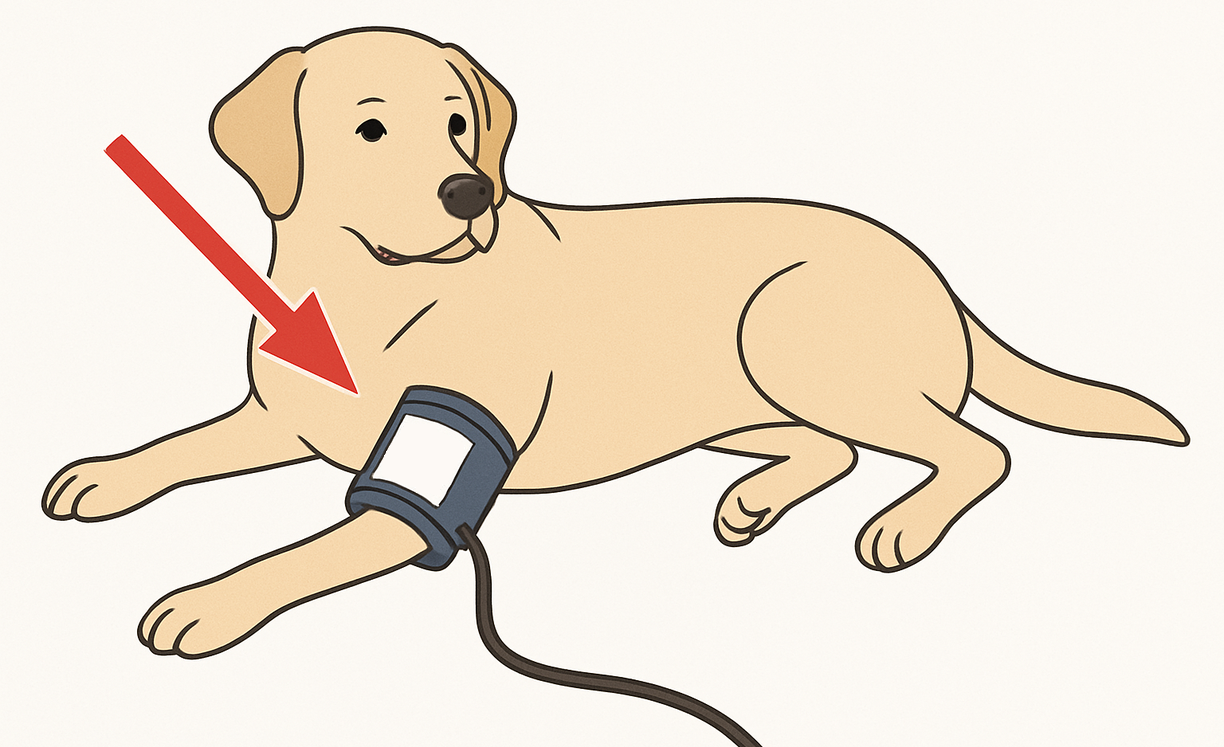
Before even looking at the cuffs, measure your pet! Choose the location where you intend to apply the cuff. The most common and recommended options are:
- Forelimb: Above the carpal joint (the animal’s “wrist”).
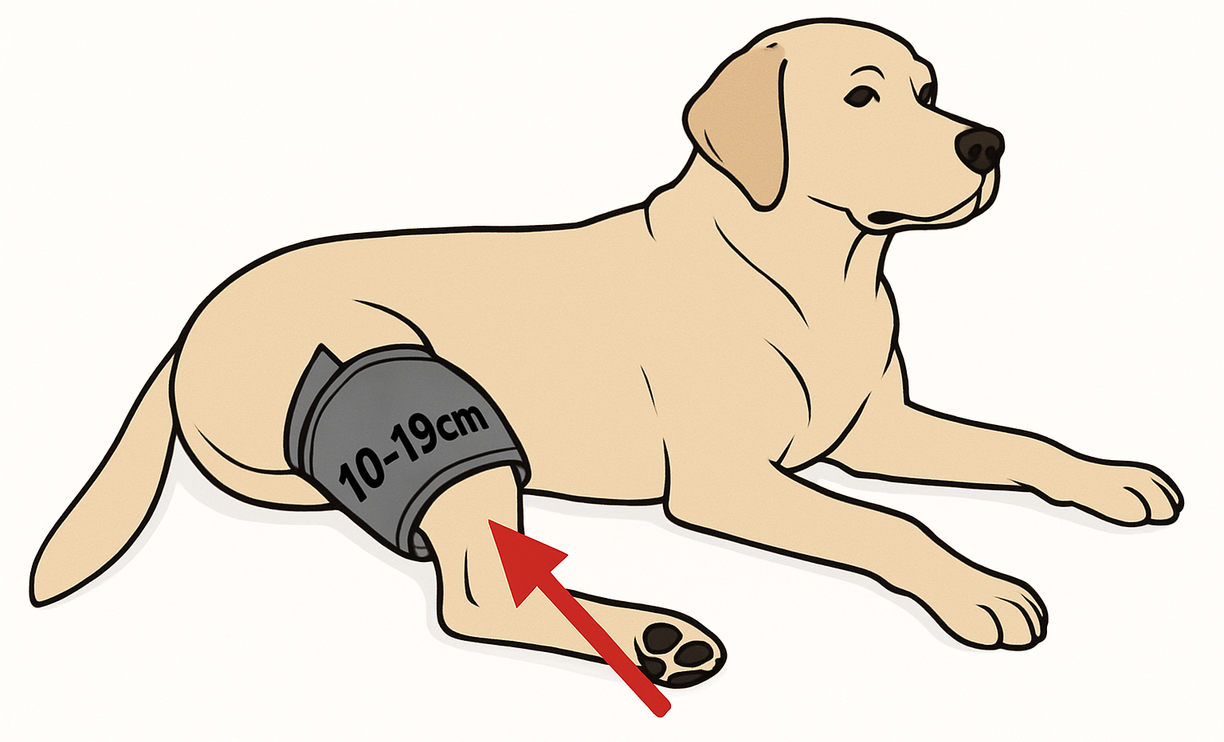
- Hind Limb: On the thigh, the highest and most muscular part of the leg.
- Tail Base: Especially useful in cats or animals where the limbs are difficult to access. The circumference tends to be more uniform in this location.
Use a
flexible measuring tape (like a tailor’s tape) and wrap it around the limb at the chosen site, without tightening it too much or leaving it too loose. Note the measurement in centimetres.
Golden Rule: The
width of the inflatable bladder of the cuff (not the total width of the fabric, but the inner part that inflates) should be approximately
40% of the limb circumference in dogs and
30% in cats. Although the cuffs come with recommended circumference ranges, this rule helps to understand the principle behind the choice.
Step 2: Choosing the Contec 08a Cuff Size
With the circumference measurement in hand, compare it with the cuff sizes available for the Contec 08a:
1. Small Cuff (Circumference: 4 cm to 8 cm)
Ideal for:
- Cats: Most adult breeds.
- Miniature Dogs/Puppies: Chihuahua, Yorkshire Terrier, Miniature Pinscher, etc.
Illustrated Application Sites:
2. Medium Cuff (Circumference: 6 cm to 11 cm)
Ideal for:
- Small to Medium-Sized Dogs: Beagle, Miniature/Toy Poodle, Shih Tzu, Dachshund, Jack Russell Terrier, etc.
- Large Breed Cats: Maine Coon, Ragdoll, etc.
Illustrated Application Sites:
Medium Dog – Hind Limb (Thigh):
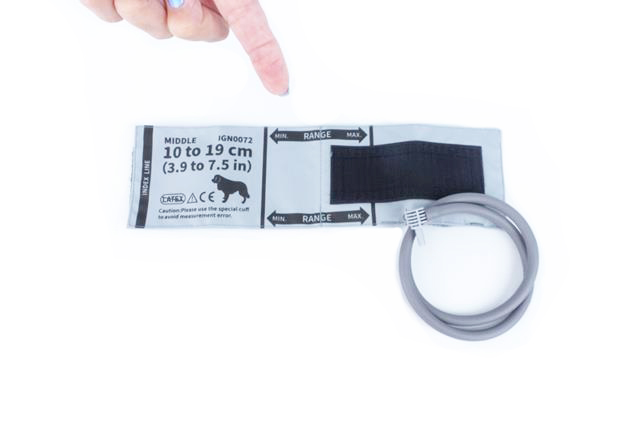
3. Large Cuff (Circumference: 10 cm to 19 cm)
Ideal for:
- Medium to Large-Sized Dogs: Labrador Retriever, Golden Retriever, German Shepherd, Boxer, Dalmatian, Border Collie, etc.
- Large Dogs (e.g., 54 kg): This is the most likely size, but always confirm by measuring the limb circumference.
Illustrated Application Sites:
Large Dog – Hind Limb (Thigh):
Important Note: Giant breed dogs may exceed 19 cm in circumference, requiring special cuffs.
Tip: If your pet’s measurement falls exactly on the border between two sizes, the general recommendation is to opt for the larger size. Also check the “Index” and “Range” markings on the cuff itself: when applied, the “Index” line should fall within the “Range” area.
Step 3: Applying the Cuff and Taking the Measurement
With the correct cuff in hand, follow these tips for a successful measurement:
- Calm Environment: Choose a quiet place where your pet feels safe and relaxed. Avoid measuring immediately after play or excitement.
- Comfortable Position: Let the animal lie down or sit calmly. If awake, try to keep the limb with the cuff elevated to heart level.
- Correct Application: Wrap the cuff around the chosen limb. Fasten the Velcro so it is snug, but not tight. You should be able to slip a small finger between the cuff and the skin. If there is an artery marker, align it with the main artery of the limb (usually on the inner side).
- Connection: Connect the cuff tube firmly to the corresponding port on the Contec 08a monitor. Ensure there are no kinks or leaks in the tube.
- Device Configuration: Check if your Contec 08a allows you to select the animal type (Dog/Cat) or cuff size (Small/Medium/Large) and adjust as necessary. Consult your device manual for this information.
- Start Measurement: Press the button to start the measurement and keep the animal as still as possible until the device displays the result.
- Repeat Measurement: Do not rely solely on the first reading! Wait a minute and take at least two more measurements. Discard the first reading and consider the average of the subsequent readings or the most consistent values.
Troubleshooting Common Problems
- Monitor Cycling Without Result: Check the cuff fit (must not be too loose or too tight), the animal’s calmness, the tube connections, and the device settings (animal type/cuff size).
- Inconsistent Readings: Ensure the cuff size is correct, the application is appropriate, the animal is calm, and measurements are taken under the same conditions (same location, time, position).
Frequently Asked Questions (FAQ)
How do I know if the cuff is too tight or too loose?
The ideal fit is “snug”. It shouldn’t be so tight as to cause discomfort or impede circulation, nor so loose that it slips on the limb. A good tip is to try slipping a small finger between the cuff and the pet’s skin; if you can do so with slight resistance, the fit is likely good. If a lot of the Velcro is exposed when fastened, it might be a sign the cuff is too small.
Where do I connect the cuff tube to the Contec 08a device?
There is usually a specific circular connection port for the cuff tube on the side or back of the Contec 08a monitor. Ensure the connection is firm and leak-free. Some models may have a locking mechanism (like sliding a silver piece) to secure the connection.
How accurate are the readings from this device?
The Contec 08a typically has an accuracy of ± 3 mmHg for blood pressure. It is considered suitable for home monitoring and tracking but does not replace hospital-grade clinical equipment for complex diagnoses.
Why does the monitor keep trying to measure multiple times without a result (cycling)?
This can happen for several reasons:
- Incorrect Cuff Fit: If it’s too loose or too tight, the device may struggle to get a reading.
- Animal Movement/Agitation: The pet needs to be as calm and still as possible during the measurement.
- Connection Problems: Check that the tube is securely connected to the cuff and the device, without kinks or leaks.
- Device Settings: Some veterinary devices require the animal type (dog/cat) or cuff size to be selected in the menu. Check if your Contec 08a has this option and if it’s set correctly.
How long does it take for the device to show the pressure?
The process of inflating, measuring, and deflating can take some time, varying slightly with each measurement. Some users report the device can seem a bit slow, so be patient and keep the animal calm during the process.
Can I use a human cuff on my pet?
It is not recommended. Human blood pressure cuffs and devices are calibrated and designed for human anatomy and physiology. To obtain accurate readings in animals, always use cuffs and monitors specifically designed for veterinary use, like the Contec 08a and its corresponding cuffs.
What is the best place to put the cuff (forelimb, hind limb, tail)?
The most common sites are the forelimb (above the “elbow” or carpus/wrist), the hind limb (on the thigh), or the tail base (especially in cats). The choice may depend on the animal and ease of access. The tail base can offer a more uniform circumference. Consult your veterinary surgeon to find out the most suitable site for your pet.
How do I measure the limb/tail circumference correctly?
Use a flexible measuring tape. Wrap it around the limb at the site where the cuff will be applied, without pulling the tape tight or leaving it loose. Note the measurement in centimetres. Remember that the width of the cuff’s inflatable bladder should be approximately 40% of this circumference in dogs and 30% in cats.
What do the “Range” and “Index” markings on the cuff mean?
Many veterinary cuffs have markings to aid fitting. The “Index” line should fall within the area marked as “Range” when the cuff is fastened on the animal’s limb. This confirms that the cuff size is appropriate for that circumference.
My pet is between two cuff sizes, which one should I choose?
The general recommendation, based on veterinary practices and the analysed video, is to opt for the larger of the two sizes. A slightly large cuff tends to provide more reliable readings than one that is too small, which can overestimate the pressure.
Do I need to configure anything on the device before measuring?
Check your Contec 08a manual or the menu options. Some veterinary monitors require you to select the animal type (dog/cat) or confirm the cuff size being used (Small/Medium/Large). Setting this correctly is important for accuracy.
Is the first reading reliable? How many times should I measure?
Do not rely solely on the first reading, as the animal may be adjusting to the process. It is recommended to take at least three consecutive measurements with a short interval between them. Discard the first reading and consider the average of the subsequent readings or the most consistent readings.
What should I do if I still have questions?
If you have any doubts about the cuff size, application site, measurement technique, or interpretation of the results, always consult your veterinary surgeon. They are the best-qualified professional to guide you.
Final Conclusion
We hope this comprehensive guide makes using your Contec 08a monitor easier and helps ensure more accurate and consistent blood pressure measurements for your dog or cat. Remember that choosing the correct cuff, careful application, and patience during the procedure are fundamental. Regular monitoring, done correctly, is a powerful tool for tracking your pet’s health in collaboration with your veterinary surgeon.